CLASSIC
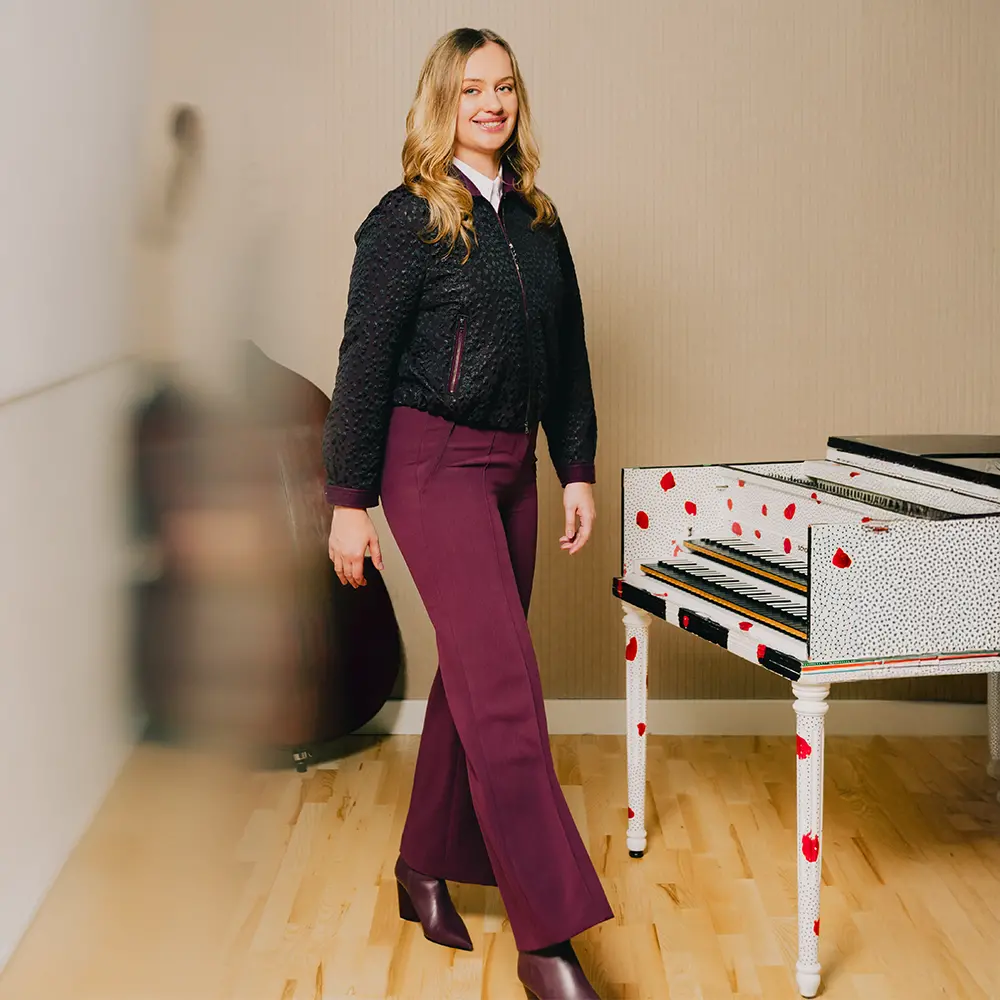
Carolin Anna Pichler composes for all instruments, primarily for classical ones but also for jazz ensembles and the Irish fiddle. During her studies, she also learnt to play the harpsichord, which is regarded as the precursor to the piano.
CLASSIC
Carolin Anna Pichler composes for all instruments, primarily for classical ones but also for jazz ensembles and the Irish fiddle. During her studies, she also learnt to play the harpsichord, which is regarded as the precursor to the piano.
When applause breaks out after the
premiere of a concert, an opera or a
musical, it is directed at the performers,
the musicians and the conductor.
This moment is also a special one for
Carolin Anna Pichler – the music was written by her.
As a composer, the 29-year-old is brought onto the
stage right at the very end and greeted with cheers
from the audience.
We meet the musician for a photo shoot in her adopted home of Salzburg, where she has been living for three years. The interview was conducted on Zoom beforehand. Carolin is sitting in her flat; behind her is a workspace with music studio equipment and record covers hang on the wall. She exudes a calm, unhurried serenity. We want to know where she gets her ideas from. “I realised quite early on that melodies spring to mind as soon as I play a note or two on the piano,” she says. “But in my head, I can hear even more. Sequences of notes for other instruments, a whole orchestra. It just comes naturally.”
Carolin wrote her first songs at the age of 14, her first musical at 17 and at 26 became a resident composer at the Salzburg State Theatre. Her job there is to compose, write the lyrics for and produce musicals and theatre music. “As musical director, I also rehearse the pieces with the performers,” she explains. She works as a freelancer; her repertoire for ensembles and orchestras ranges from classical and contemporary experimental music through to jazz and pop. She is currently the artistic director of the summer theatre in Katschberg, and at the end of the year she will celebrate the premiere of the musical “The Sound of Industry”. Carolin specialises in musical theatre and is also proud to be one of the very few to offer both music and lyrics from a single source. “Perhaps my greatest talent,” she remarks.
We meet the musician for a photo shoot in her adopted home of Salzburg, where she has been living for three years. The interview was conducted on Zoom beforehand. Carolin is sitting in her flat; behind her is a workspace with music studio equipment and record covers hang on the wall. She exudes a calm, unhurried serenity. We want to know where she gets her ideas from. “I realised quite early on that melodies spring to mind as soon as I play a note or two on the piano,” she says. “But in my head, I can hear even more. Sequences of notes for other instruments, a whole orchestra. It just comes naturally.”
Carolin wrote her first songs at the age of 14, her first musical at 17 and at 26 became a resident composer at the Salzburg State Theatre. Her job there is to compose, write the lyrics for and produce musicals and theatre music. “As musical director, I also rehearse the pieces with the performers,” she explains. She works as a freelancer; her repertoire for ensembles and orchestras ranges from classical and contemporary experimental music through to jazz and pop. She is currently the artistic director of the summer theatre in Katschberg, and at the end of the year she will celebrate the premiere of the musical “The Sound of Industry”. Carolin specialises in musical theatre and is also proud to be one of the very few to offer both music and lyrics from a single source. “Perhaps my greatest talent,” she remarks.
When applause breaks out after the
premiere of a concert, an opera or a
musical, it is directed at the performers,
the musicians and the conductor.
This moment is also a special one for
Carolin Anna Pichler – the music was written by her.
As a composer, the 29-year-old is brought onto the
stage right at the very end and greeted with cheers
from the audience.
We meet the musician for a photo shoot in her adopted home of Salzburg, where she has been living for three years. The interview was conducted on Zoom beforehand. Carolin is sitting in her flat; behind her is a workspace with music studio equipment and record covers hang on the wall. She exudes a calm, unhurried serenity. We want to know where she gets her ideas from. “I realised quite early on that melodies spring to mind as soon as I play a note or two on the piano,” she says. “But in my head, I can hear even more. Sequences of notes for other instruments, a whole orchestra. It just comes naturally.”
Carolin wrote her first songs at the age of 14, her first musical at 17 and at 26 became a resident composer at the Salzburg State Theatre. Her job there is to compose, write the lyrics for and produce musicals and theatre music. “As musical director, I also rehearse the pieces with the performers,” she explains. She works as a freelancer; her repertoire for ensembles and orchestras ranges from classical and contemporary experimental music through to jazz and pop. She is currently the artistic director of the summer theatre in Katschberg, and at the end of the year she will celebrate the premiere of the musical “The Sound of Industry”. Carolin specialises in musical theatre and is also proud to be one of the very few to offer both music and lyrics from a single source. “Perhaps my greatest talent,” she remarks.
We meet the musician for a photo shoot in her adopted home of Salzburg, where she has been living for three years. The interview was conducted on Zoom beforehand. Carolin is sitting in her flat; behind her is a workspace with music studio equipment and record covers hang on the wall. She exudes a calm, unhurried serenity. We want to know where she gets her ideas from. “I realised quite early on that melodies spring to mind as soon as I play a note or two on the piano,” she says. “But in my head, I can hear even more. Sequences of notes for other instruments, a whole orchestra. It just comes naturally.”
Carolin wrote her first songs at the age of 14, her first musical at 17 and at 26 became a resident composer at the Salzburg State Theatre. Her job there is to compose, write the lyrics for and produce musicals and theatre music. “As musical director, I also rehearse the pieces with the performers,” she explains. She works as a freelancer; her repertoire for ensembles and orchestras ranges from classical and contemporary experimental music through to jazz and pop. She is currently the artistic director of the summer theatre in Katschberg, and at the end of the year she will celebrate the premiere of the musical “The Sound of Industry”. Carolin specialises in musical theatre and is also proud to be one of the very few to offer both music and lyrics from a single source. “Perhaps my greatest talent,” she remarks.


It took some time for this talent to be discovered
and nurtured. Carolin Anna Pichler grew up in
Carinthia,
Austria. “There were musical events in almost
every village and my parents always took me
along,” she recalls. She was allowed to try out different
things; she learnt to play the guitar at the age of four
and switched to the piano at seven. At the age of ten,
she passed the entrance exam for her school’s music
stream – quite a nerve-racking experience for most
people,
but not for her. “The panel probably accepted me
back then because I just kept singing, even though the
break bell was ringing loudly in the background.”
From then on, she accompanied the choir on the piano at her school. She often spent her lunch breaks in the music room; only a few of her friends knew that she loved to improvise and make up her own songs there. When she was 14, she performed one of these songs at a school concert. “A few friends persuaded me to do it. I thought nobody would want to hear it. But then I did it anyway,” she says. And it’s a good thing she did. Her teachers were so impressed that she began taking composition lessons from then on. She learnt how to develop a theme, how counterpoint – the interweaving of several different melodies – works, how pieces are structured and how they are orchestrated, i.e arranged for an orchestra.
From then on, she accompanied the choir on the piano at her school. She often spent her lunch breaks in the music room; only a few of her friends knew that she loved to improvise and make up her own songs there. When she was 14, she performed one of these songs at a school concert. “A few friends persuaded me to do it. I thought nobody would want to hear it. But then I did it anyway,” she says. And it’s a good thing she did. Her teachers were so impressed that she began taking composition lessons from then on. She learnt how to develop a theme, how counterpoint – the interweaving of several different melodies – works, how pieces are structured and how they are orchestrated, i.e arranged for an orchestra.
It took some time for this talent to be discovered
and nurtured. Carolin Anna Pichler grew up in
Carinthia,
Austria. “There were musical events in almost
every village and my parents always took me
along,” she recalls. She was allowed to try out different
things; she learnt to play the guitar at the age of four
and switched to the piano at seven. At the age of ten,
she passed the entrance exam for her school’s music
stream – quite a nerve-racking experience for most
people,
but not for her. “The panel probably accepted me
back then because I just kept singing, even though the
break bell was ringing loudly in the background.”
From then on, she accompanied the choir on the piano at her school. She often spent her lunch breaks in the music room; only a few of her friends knew that she loved to improvise and make up her own songs there. When she was 14, she performed one of these songs at a school concert. “A few friends persuaded me to do it. I thought nobody would want to hear it. But then I did it anyway,” she says. And it’s a good thing she did. Her teachers were so impressed that she began taking composition lessons from then on. She learnt how to develop a theme, how counterpoint – the interweaving of several different melodies – works, how pieces are structured and how they are orchestrated, i.e arranged for an orchestra.
From then on, she accompanied the choir on the piano at her school. She often spent her lunch breaks in the music room; only a few of her friends knew that she loved to improvise and make up her own songs there. When she was 14, she performed one of these songs at a school concert. “A few friends persuaded me to do it. I thought nobody would want to hear it. But then I did it anyway,” she says. And it’s a good thing she did. Her teachers were so impressed that she began taking composition lessons from then on. She learnt how to develop a theme, how counterpoint – the interweaving of several different melodies – works, how pieces are structured and how they are orchestrated, i.e arranged for an orchestra.

COLLABORATION
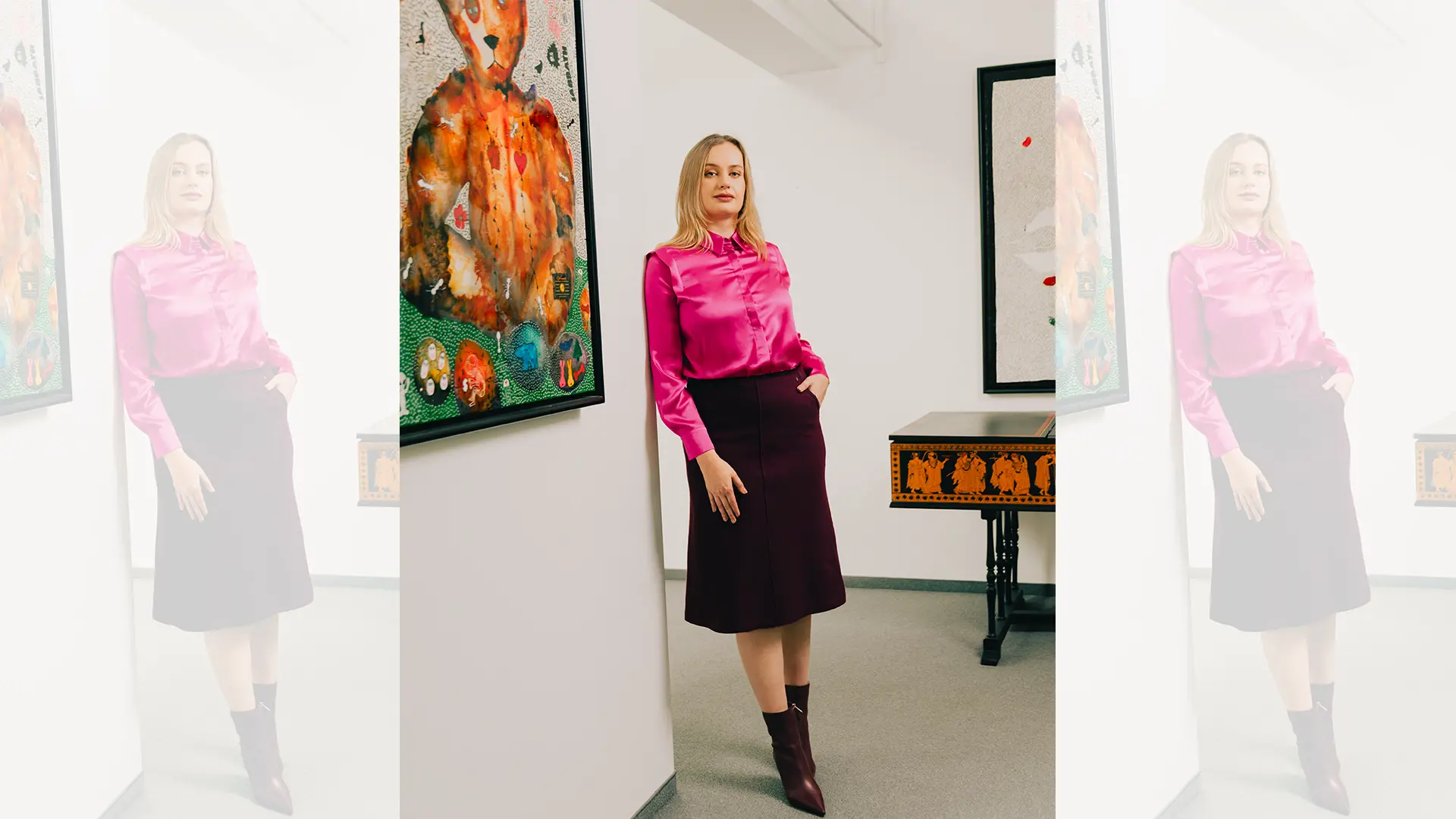
Carolin writes the music and lyrics for musicals. However, she also works with Mozart’s music, for example on editions for the Salzburger Konzertgesellschaft, where the photo shoot also took place.
When she practises new pieces these days, she
particularly enjoys the rehearsals and working with the
performers. “For new compositions, I set aside a week to
rehearse my music with the soloists and explain what
I had in mind,” she says. She enjoys the process very
much. As well as creativity, she also counts empathy and
focusing on solutions among her strengths. “You need
to be able to respond to others.” Sometimes she is mistaken
for a singer or an actress, rather than the composer:
“I’m still relatively young and I don’t know anyone
my age – at least in Austria – who specialises in musical
theatre.” She then makes it clear who’s in charge, and
that isn’t a problem. “It works well in the group and
I think I’m quite nice too,” she says with a grin.
Carolin performed in her first musical while she was still at school. She then went on to study composition and music theory at the Gustav Mahler Private University in Klagenfurt, alongside cultural studies, so that she could gain an insight into the organisational side of things, she explains. She cannot say for certain which is more important for her job – talent or hard work. “A mixture, perhaps. I worked a lot while I was at university, but I was never the sort to practise extensively. A lot of things came easily to me as long as I could recognise the patterns.” Carolin needs a plan, whether it’s for an operetta aria, songs for children’s plays, symphonic works or musicals. She then takes a strategic approach, working from the big picture down to the details, considering how many acts and how many scenes per act she needs. The lyrics only come right at the very end.
Carolin performed in her first musical while she was still at school. She then went on to study composition and music theory at the Gustav Mahler Private University in Klagenfurt, alongside cultural studies, so that she could gain an insight into the organisational side of things, she explains. She cannot say for certain which is more important for her job – talent or hard work. “A mixture, perhaps. I worked a lot while I was at university, but I was never the sort to practise extensively. A lot of things came easily to me as long as I could recognise the patterns.” Carolin needs a plan, whether it’s for an operetta aria, songs for children’s plays, symphonic works or musicals. She then takes a strategic approach, working from the big picture down to the details, considering how many acts and how many scenes per act she needs. The lyrics only come right at the very end.
When she practises new pieces these days, she
particularly enjoys the rehearsals and working with the
performers. “For new compositions, I set aside a week to
rehearse my music with the soloists and explain what
I had in mind,” she says. She enjoys the process very
much. As well as creativity, she also counts empathy and
focusing on solutions among her strengths. “You need
to be able to respond to others.” Sometimes she is mistaken
for a singer or an actress, rather than the composer:
“I’m still relatively young and I don’t know anyone
my age – at least in Austria – who specialises in musical
theatre.” She then makes it clear who’s in charge, and
that isn’t a problem. “It works well in the group and
I think I’m quite nice too,” she says with a grin.
Carolin performed in her first musical while she was still at school. She then went on to study composition and music theory at the Gustav Mahler Private University in Klagenfurt, alongside cultural studies, so that she could gain an insight into the organisational side of things, she explains. She cannot say for certain which is more important for her job – talent or hard work. “A mixture, perhaps. I worked a lot while I was at university, but I was never the sort to practise extensively. A lot of things came easily to me as long as I could recognise the patterns.” Carolin needs a plan, whether it’s for an operetta aria, songs for children’s plays, symphonic works or musicals. She then takes a strategic approach, working from the big picture down to the details, considering how many acts and how many scenes per act she needs. The lyrics only come right at the very end.
Carolin performed in her first musical while she was still at school. She then went on to study composition and music theory at the Gustav Mahler Private University in Klagenfurt, alongside cultural studies, so that she could gain an insight into the organisational side of things, she explains. She cannot say for certain which is more important for her job – talent or hard work. “A mixture, perhaps. I worked a lot while I was at university, but I was never the sort to practise extensively. A lot of things came easily to me as long as I could recognise the patterns.” Carolin needs a plan, whether it’s for an operetta aria, songs for children’s plays, symphonic works or musicals. She then takes a strategic approach, working from the big picture down to the details, considering how many acts and how many scenes per act she needs. The lyrics only come right at the very end.

HARMONY
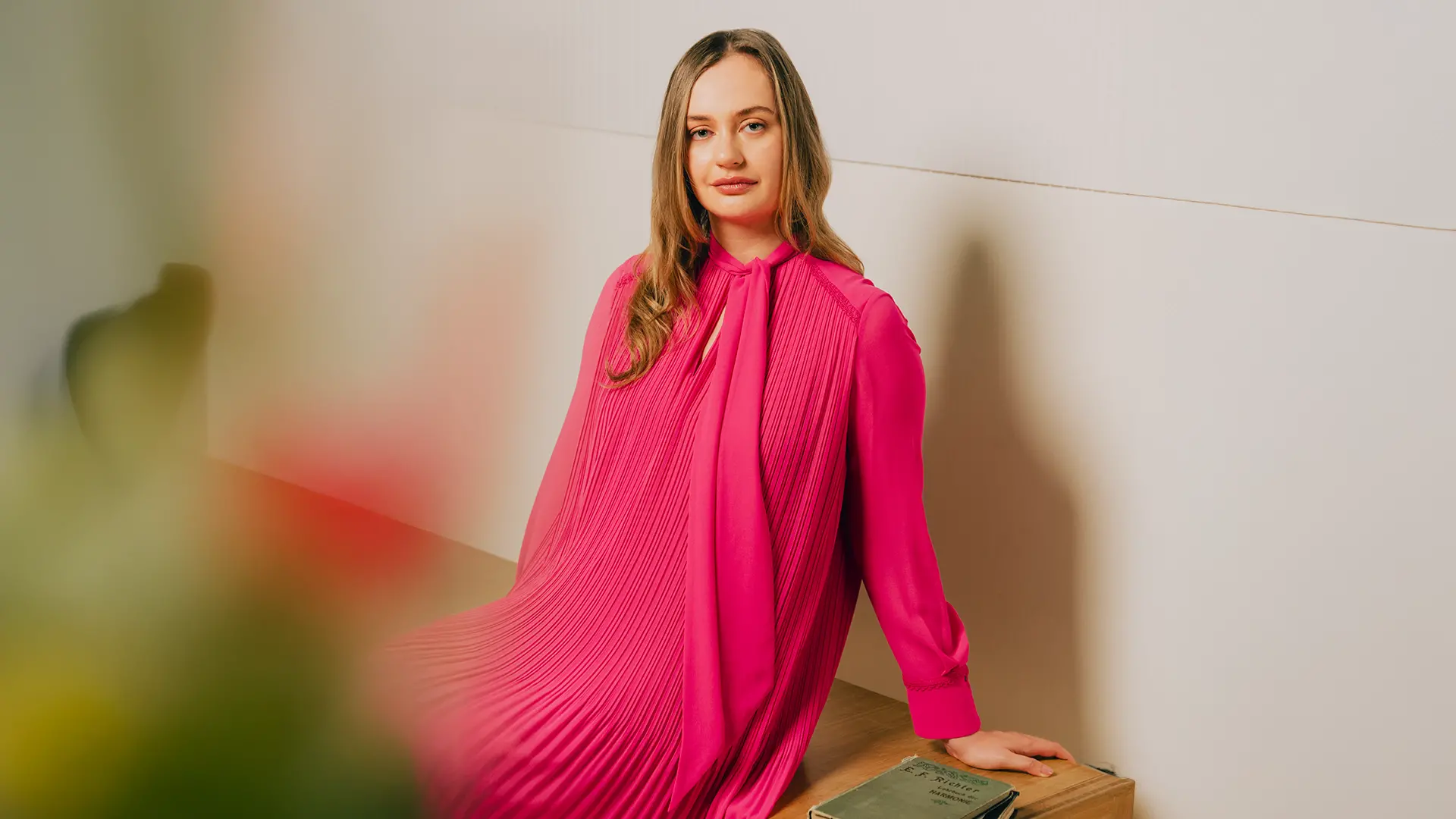
Carolin’s music stirs emotions. The book on harmony (above) is a classic; it deals with the structure of chords and how to build suspense, among other things.
And when she’s not making music? “I love getting
out into nature, driving to Lake Fuschl or strolling
through Salzburg’s beautiful old town,” she enthuses.
Would she like to meet Mozart, Salzburg’s most famous
son? “It would be an honour, of course. I work with his
music, for example on editions or arrangements of the
scores for the Salzburger Konzertgesellschaft. But I’d
also love to chat with some of Broadway’s earlier composers
and talk to Gershwin about his time there.” At
lunchtime, she can often be seen having lunch with her
colleagues. In the evenings, Carolin goes out a lot – to
the theatre and to concerts. In Salzburg, it’s not uncommon
to come across numerous internationally renowned
artists and musicians. She thinks it’s always
interesting to share experiences. When she has time,
Carolin relaxes by doing yoga or pilates or by cooking
for friends. In the evenings, rock music can sometimes
be heard coming from her flat. She points at the record
cover behind her on the wall. “For Those About to
Rock” by AC/DC. “Cool, right? It was a present. I tend to
collect things from people I like.” She gets up and
returns with a handful of items: collages, polaroids,
a little ceramic house, ensemble caricatures, a homemade
disco ball.
What is her big dream? “Obviously I’d like to work on an even more international scale or for even bigger companies. But the most important thing for me is to bring people together and perform my music on stage.”
What is her big dream? “Obviously I’d like to work on an even more international scale or for even bigger companies. But the most important thing for me is to bring people together and perform my music on stage.”
And when she’s not making music? “I love getting
out into nature, driving to Lake Fuschl or strolling
through Salzburg’s beautiful old town,” she enthuses.
Would she like to meet Mozart, Salzburg’s most famous
son? “It would be an honour, of course. I work with his
music, for example on editions or arrangements of the
scores for the Salzburger Konzertgesellschaft. But I’d
also love to chat with some of Broadway’s earlier composers
and talk to Gershwin about his time there.” At
lunchtime, she can often be seen having lunch with her
colleagues. In the evenings, Carolin goes out a lot – to
the theatre and to concerts. In Salzburg, it’s not uncommon
to come across numerous internationally renowned
artists and musicians. She thinks it’s always
interesting to share experiences. When she has time,
Carolin relaxes by doing yoga or pilates or by cooking
for friends. In the evenings, rock music can sometimes
be heard coming from her flat. She points at the record
cover behind her on the wall. “For Those About to
Rock” by AC/DC. “Cool, right? It was a present. I tend to
collect things from people I like.” She gets up and
returns with a handful of items: collages, polaroids,
a little ceramic house, ensemble caricatures, a homemade
disco ball.
What is her big dream? “Obviously I’d like to work on an even more international scale or for even bigger companies. But the most important thing for me is to bring people together and perform my music on stage.”
What is her big dream? “Obviously I’d like to work on an even more international scale or for even bigger companies. But the most important thing for me is to bring people together and perform my music on stage.”
CREDITS
Photography: Vincent Forstenlechner, Production: Vanessa Zeeh, Styling: Julia Malin, Hair & Make-up: Nil Stranzinger, Photography assistant: Helena Kalleitner
Photography: Vincent Forstenlechner, Production: Vanessa Zeeh, Styling: Julia Malin, Hair & Make-up: Nil Stranzinger, Photography assistant: Helena Kalleitner